






Founder & Chief Engineer | Edge Systems, Embedded Compute & Multimodal AI | 19+ Patents
San Carlos, California · Ekhos-Phos · LinkedIn · GitHub
Founder and chief engineer building system-level edge-AI hardware for assistive technology and physical security—multimodal perception, embedded compute, sensor fusion, and on-device auditory guidance. Transitioning from a decade of production audio/acoustics at Apple, Google, Meta, Snap, Waymo, Tesla, Alarm.com, and 1X into embedded vision, FPGA DSP, inertial sensing, and edge-AI architecture. Inventor on 19+ pending and granted U.S. patent matters.
What we’re building now. At Ekhos-Phos, multimodal edge-AI hardware and engineering infrastructure for assistive technology, physical security, and intelligent sensing. Product and system details remain private; selected inventions are under pending U.S. patent filings.
How the technical foundation is expanding. Part-time Dartmouth M.Eng. work deepens the stack into MIPI CSI-2 camera pipelines, Sobel edge detection, AXI-Stream I2S/FIR DSP, SPI IMU calibration, UART-to-BLE telemetry, CNN/U-Net perception, GAN transfer, and edge-AI system architecture. Those capabilities feed the company work above—and strengthen every tool in this repository.
This site centers on R&D tools and projects: practical methods for prototyping, measuring, and validating audio, sensing, and embedded systems.
| Domain | Capabilities |
|---|---|
| Audio & Acoustics | Transducer design, microphone arrays, loudspeakers, spatial audio, beamforming, direction of arrival, echo control, acoustic measurement and validation |
| Vision, Sensors & Edge | MIPI CSI-2 / D-PHY, SCCB / I2C camera control, AXI4-Stream video, FPGA camera pipelines, Gaussian blur / Sobel edge detection, RGB / HDMI, SPI IMU bring-up, sensor calibration, multimodal perception, edge-AI system architecture |
| Embedded Systems & FPGA DSP | Embedded Linux, real-time signal processing, VHDL, I2S audio, AXI-Stream / AXI FIFOs, fixed-point FIR, SPI / UART / USART / I2C, ADC, GPIO, BTLE / Nordic UART Service, ESP32-C3, STM32, hardware/software bring-up |
| On-Device Intelligence | CNNs with GAP heads, U-Net segmentation, bounding-box regression, DCGAN transfer and sample-efficient GAN training, compact / small language model concepts at the edge, TensorFlow / KerasTuner, evaluation under constrained compute, power, and model size |
| Programming, ML & Data | Python, C, C++, VHDL, MATLAB, TensorFlow, NumPy, Pandas, SciPy, scikit-learn, librosa, statistical analysis and manufacturing analytics |
| Modeling & Hardware | Git, Xilinx Vitis/Vivado, FPGA platforms, Raspberry Pi, STM32, COMSOL, SPICE, SolidWorks, FEA, oscilloscopes, logic analyzers |
- Audio Test App
- Loudspeaker LPM Simulation Tool
- Loudspeaker Magnetics Simulation Tool
- Dartmouth Graduate Studies
Python measurement toolkit—and browser dashboard—for loudspeaker and audio-system validation on real hardware. Highlights include:
- Stimulus generation — noise and exponential sweeps for system excitation
- Play / record — drive an output while capturing from selected input devices (or record alone)
- Loudspeaker characterization — frequency response, distortion, and related impulse-response views from sweep captures
- Microphone tests — DUT mic measurements against a reference path, with optional speaker flattening so the mic—not the playback chain—is what you score
- Microphone calibration — convert digital levels to SPL using a known calibrator tone
- Speaker equalization — measure-and-correct workflows to flatten a reference loudspeaker for cleaner mic work
- Speech quality (MOS) — non-intrusive MOS-style scoring on speech WAV files (no clean reference transcript required)
- Capture analysis — waveform, spectrum, spectrogram, and level statistics on recorded takes
Runs on lab benches and remote hosts (including Raspberry Pi-class deployments). Implementation details are proprietary.
Demo: Audio Test App on YouTube
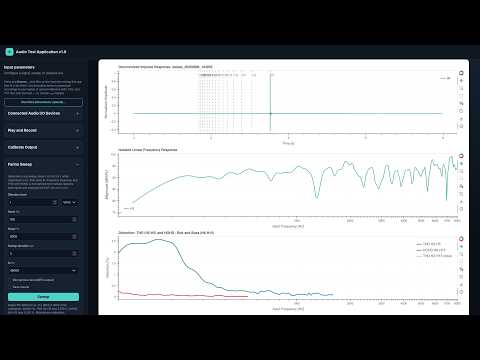
Stills

Browser-based loudspeaker linear-parameter (LPM) simulator for comparing two driver/system designs side by side before hardware builds. Highlights include:
- Dual-system compare — edit two loudspeakers in parallel and see differences immediately
- Enclosure types — closed-back, bass-reflex, and passive-radiator models per speaker
- Response plots — frequency response (SPL), cone excursion, impedance, and port velocity / passive-radiator excursion
- Derived constants — design quantities such as
Vas,fs,Qts,BL, sensitivity, thermal limits, and related enclosure/port parameters - Interactive dashboard — live plots and a calculated-constants table as parameters change
Runs locally or on remote hosts (including Raspberry Pi-class deployments). Implementation details are proprietary.
Demo: Loudspeaker LPM on YouTube
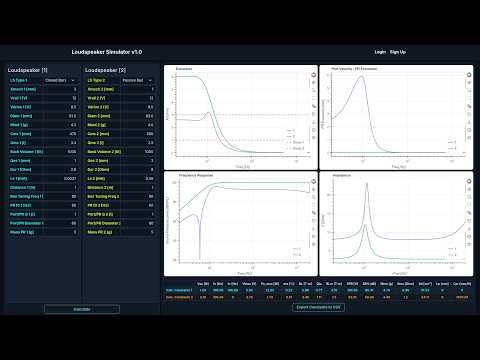
Stills

Finite-element magnetics workflow for loudspeaker motor design—iterate the magnetic circuit from geometry before cutting metal. Highlights include:
- Voice-coil geometry — turn count, DC resistance, dimensions, and moving mass from wire and bobbin inputs
- Motor force factor — estimate
BLand related electromotive properties from pole, magnet, and coil layout - Mass & packaging — motor mass and volume for system-level trade studies
- Field visualization — flux-density heat maps of the motor domain
- Stroke behavior — non-linear
BL(x)curves across excursion for motor linearity checks
Implementation details are proprietary.
Demo: Loudspeaker Magnetics on YouTube
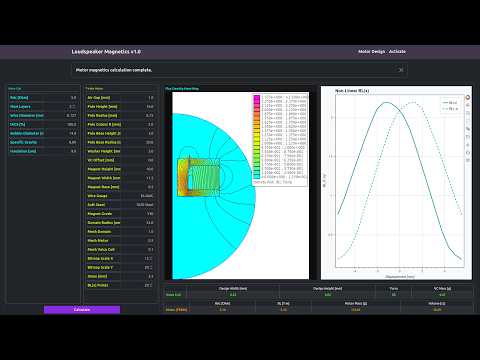
Stills

Part-time M.Eng. Computer Engineering work spanning embedded bring-up, FPGA audio DSP and machine vision, classical ML, and a deep-learning sequence in classification, segmentation/detection, and generative models.
Dartmouth graduate embedded / FPGA lab work spanning an STM32F042 Nucleo-32 (STM32F042K6) and a Xilinx Zybo Z7-20 (Zynq) platform in Vivado / Vitis—bare-metal C on the MCU side, plus FPGA streaming audio DSP and real-time machine-vision pipelines, with Digilent Analog Discovery / WaveForms validation where applicable.
STM32F042 Nucleo
- Toolchain & debug — J-Link / GDB bring-up, firmware flash, and VS Code remote debug workflows
- GPIO & instrumentation — LED I/O characterization with WaveForms scope / wavegen; breadboard probing of MCU pins
- USART — alternate-function pin mux, interrupt-driven RX callbacks, and
printf-style host logging - Clocks, SysTick & PWM — internal clock configuration, exception/callback patterns, PWM duty-cycle control, RC filtering, and LED dimming
- ADC & sampling — sample-time / input-impedance tradeoffs, interrupt and DMA capture paths, Nyquist checks, timer-triggered sampling, and digital filtering
- SPI sensing — LIS3DH accelerometer over SPI with logic-analyzer decode, interrupt-driven acquisition, and orientation plots
- BTLE bridge — UART-to-BTLE character loopback and streaming accelerometer data to a web device CLI
- Fixed-point DSP — moving-average → fixed-point FIR, offset/scale calibration in Q-format, plus code-size and processing-time tradeoffs vs. floating point
Xilinx Zynq — AXI-Stream I2S audio DSP
- AXI-Stream I2S wrappers — VHDL transmitter / receiver with RTL schematics, testbenches, and timing closure through metastability fixes in the I2S path
- Streaming datapath — dual AXI-Stream FIFOs between record and play paths, wired with PS, AXI IIC (codec control), and an Integrated Logic Analyzer for on-chip debug
- Hardware audio pass-through — AD3 scope validation of clean sine pass-through (matched frequencies, no glitches) plus time- and frequency-domain loopback / noise-floor checks
- Selectable FIR filters — button-selected low-pass, high-pass, band-pass, and band-stop FIR blocks (per audio channel) inserted between record and play FIFOs
- System verification — spectrum sweeps, two-tone scope captures, Bode / attenuation plots, and real music/speech listening checks across all four filter modes
Xilinx Zynq — FPGA-based machine vision (Pcam 5C)
- Camera → HDMI pass-through — Digilent Pcam 5C (OmniVision OV5640) on Zybo Z7-20; Vivado hardware + Vitis C++ bring-up to drive live camera output over HDMI (timing/constraint fixes for a clean display image)
- Sensor datapath tracing — photons → CIS / ADC → MIPI CSI-2 / D-PHY → SCCB camera control → AXI4-Stream video transport (VDMA, demosaic, timing) → RGB/DVI → HDMI
- Real-time edge detection — hardware
blur_edge_detectpath with BRAM line buffers, 3×3 windowing, Gaussian blur, and Sobel Gx/Gy edge maps; board switches (SW2 / SW3) toggle live among raw, grayscale/Gaussian, and Sobel edge-detect HDMI output - Latency & resources — block-level transient and steady-state latency estimates (e.g. ~51 µs end-to-end at 150 MHz / 1920-wide / 3×3 kernels) plus post-implementation utilization and power context on the Zynq fabric
Stills


Short-clip music-genre classifiers (TensorFlow NN and SVM) trained on audio features via librosa. Architecture is sound; F1 settled around 0.41–0.47 on a noisy multi-genre mashup dataset.
Architecture & results
Requirements: Python 3.12.2, numpy, pandas, pickle, scikit-learn, tensorflow, librosa
Trained ~100 epochs (accuracy ~0.96, loss ~0.194 on training metrics).


Dartmouth DL sequence: compact CNNs for image classification, U-Net segmentation plus bounding-box regression, then DCGAN training, cat→dog transfer, and sample-efficient GAN optimization.
Image classification (cats vs dogs)
- Four-block CNN with GlobalAveragePooling2D instead of Flatten, tuned with KerasTuner (Adam, mild Dropout / L2)
- Tuned GAP model: 92.0% test accuracy, precision / recall / F1 ~0.92, ROC AUC 0.975 on 3,752 held-out images
- Saved model ~2.8 MB (~240k params) vs an earlier Flatten CNN at ~98 MB and ~86.5% test accuracy
- Data cleanup for corrupt JPEGs; EarlyStopping so train/val curves stayed aligned
Stills


Image segmentation, crop bootstrapping, and bounding boxes
- Tiny U-Net (538k params, ~2.1 MB) over FCN / larger U-Net after KerasTuner; pixel accuracy 0.883, pet/background AUC ~0.976, mean mask IoU 0.808, AP@0.50 0.949
- Used the segmenter to crop ~24.9k Cat/Dog images (pet + border foreground, 8% box padding) for later stages
- Box regressor on Oxford-IIIT Pet XML head boxes: head attached to the last spatial feature map (not GAP), two-stage freeze then fine-tune
- Mean IoU 0.538 (recall@0.50 0.640) vs ~0.22 for sliding-window + classifier; flip TTA + segmenter mask clamp raised mean IoU to 0.563 / AP@0.50 0.687 with no retraining
Stills


GANs and transfer learning
- 128×128 RGB DCGAN (latent dim 100; G ~2.15M params, D ~741k): upsample+Conv generator, strided-conv discriminator, one-sided label smoothing and instance noise
- Cat GAN: FID 167.8 after 100 epochs; recognizable faces from blob-like early grids
- Cat→dog transfer (10-epoch warmup + 50-epoch fine-tune, ~9 min) reached FID 281.9 vs scratch-dog FID 351.3 (~21 min)—faster usable faces, with a stronger transferred discriminator (D(fake) 0.12 vs 0.31)
Stills


Sample-efficient GAN optimization
- Ranked goals: fewer target samples, then size/latency, without collapsing quality; evaluate on FID, SSIM diversity, and grids—not adversarial loss
- Task 1: 25% AFHQ dog YOLO face crops, hinge loss, spectral-normalized D, DiffAugment, mixed cat-G / dog-D transfer; restored epoch 32 (not the last epoch) at FID 241.47 vs Project 201 transfer FID 251.22, same 2.15M generator, ~0.70 ms/image
- Historical BCE runs: 474 images beat ~1,185 on FID, so more target data was not treated as an automatic upgrade
- Task 2: full Oxford-IIIT Pet photos (pose/background in frame); YOLO “face” crops abandoned after inspection. Best quantitative run was a short fresh-D, fully unfrozen Stage-3 diagnostic (FID 273.53), not a long transferred tuner
Stills


- Dartmouth College — M.Eng. Computer Engineering (Part-Time, In Progress), Mar 2025 – Mar 2027
Featured: How Mikael Asfaw Used Dartmouth’s Online M.Eng. to Bridge Hardware, Software, and AI
Selected project themes: Pcam 5C / MIPI CSI-2 machine-vision pipelines with Gaussian blur and Sobel edge detection on Zybo Z7-20, Zynq AXI-Stream I2S audio with selectable FIR filtering, STM32 embedded IMU bring-up and fixed-point calibration, audio-genre ML, compact CNN / U-Net perception, bounding-box regression, DCGAN transfer, and sample-efficient GAN optimization. - University of Southern California — M.S. Mechanical Engineering, Aug 2012 – May 2013
- University of Southern California — B.S. Mechanical Engineering, Aug 2008 – May 2012
19+ pending and granted U.S. and international matters spanning context-aware systems, microphone arrays, spatial audio, beamforming, acoustic sensing, electroacoustic transducers, bone conduction, and embedded signal processing.
- Pending U.S. App. No. 19/560,372 — Head-Mounted Device with Contextual Awareness
- U.S. 11,586,407 — Audio data manipulation based on display orientation
- U.S. 11,620,976 — Acoustic echo cancellation based on display orientation
- U.S. 11,340,861 — Audio data manipulation based on microphone orientation
- U.S. 12,413,887 — Sintered filter material and grille design to mitigate wind noise
- U.S. 10,887,713 — Microphone defect detection
- U.S. 10,028,045 — Combined microphone and lighting device
- U.S. 10,897,672 — Speaker beam steering using microphone-array and depth-camera input
- U.S. 11,044,568 — Head-wearable apparatus for binaural audio generation
- U.S. 10,567,898 — Binaural audio generation in wearable devices
- U.S. 11,361,781 — Dynamic beamforming to improve SNR in head-worn devices
- U.S. 10,687,146 / 10,194,248 — Speaker with flex-circuit acoustic radiator
- U.S. 10,178,469 — Damping spring for transducer systems
- WO 2023/172256 — Speaker with integrated pressure sensor and barometric vent
- U.S. 9,998,829 — Bone-conduction transducer with enhanced low-frequency performance
- U.S. 9,936,301 — Composite yoke for a bone-conduction transducer
- U.S. 9,766,481 — Closed-loop audio processing for bone-conduction systems
Full schedule and claim-level summaries available upon request.
Author: Mikael Asfaw
License: Proprietary — see LICENSE.md
Created: Feb 18, 2025
Updated: Sep 27, 2026